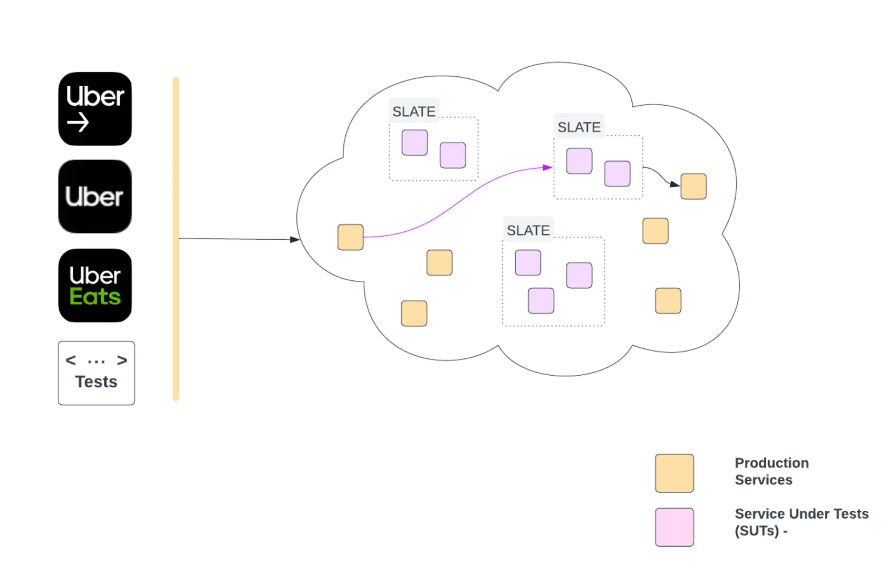
- SLATE – Short Lived Application Testing Environments
- Massively successful companies Facebook(Meta) and Uber have sophisticated testing strategies that is non traditional and “works”.
The Traditional Approaches are below

- Uber’s testing strategy is leaning forward more on “online tests” than “offline tests”
- A separate school of thought is that writing heavy unit tests is useless as it does not handle as many real world examples. At Uber, it is a microservice architecture with lots of service dependencies.
- To test new service versions, an upstream and down stream dependency behavior needs to be prepared ahead of time, and simulated similar to production environments.
- This way the behaviours are already tested with production configurations adding to higher level of confidence of deployments.
Testing Requirements:
- Up to date dependencies should be as similar to production environment as possible. Keeping staging environment similar to production has always been a big challenge, there is a different in data and config preparation
- Sharing environments between developers – there are so many developers each with their own changes. Claiming resources to test the changes is not feasible
- Live Production dependencies separated – having ability to isolate certain dependencies without affecting real users
- Cost – Reducing the cost of redundant infrastructure as spinning up services for testing can be costly for big company like Uber.
SLATE
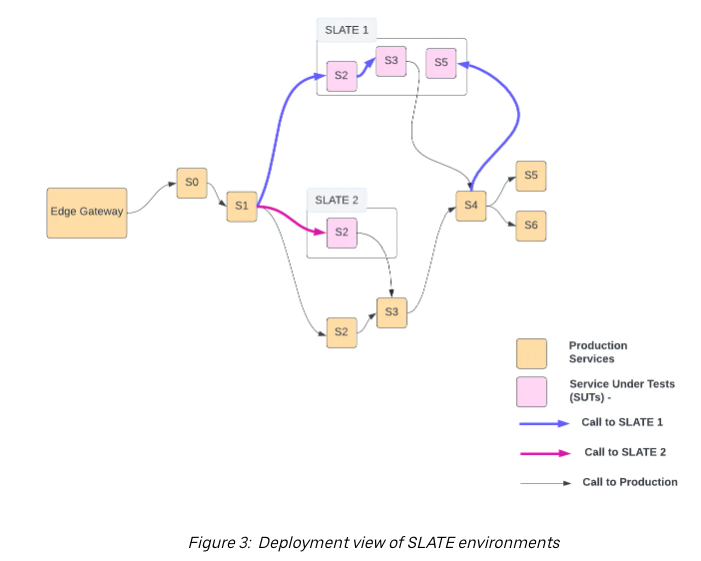
- SLATE will spin up an environment for testing isolated at Git branch or Git ref level.
- Multiple slate services can be deployed at the same time
- One kind of service can only have one Slate instance deployed at a time
- SLATE environments will automatically reclaim resources after 2 days.
Tools to support SLATE testing
- There is a library called Cadence created. It has a CLI tool to create an environments. It has many parts including a Slate Server that the CLI interacts with.
- Another library called Peloton is used to manage resources
- Uber’s infrastructure sounds like Kubernetes. The routing of requests is done via yaml files. Mesh capability is required.
- Test Accounts are created so real users are not affected.
- For observability, Jaeger Baggage is used to trace end to end.
- Developers has access to controller to handle how to route traffic.

Takeaways:
- SLATE – building short lived test microservices, and freeing up resources immediately.
- Cadence can be deployed with kubernetes, but also has docker compose deployment
- Distributed tracing with Jaeger
- Peloton for resource managing
- Config cache
- Improved testing experience and velocity for E2E testing for the company.
- Staging might be able to be deprecated in favour of using SLATE.
Ref:
- Original Blog
- Cadence Environment builder
- Peloton Resource Scheduler

 Coffee Break
Leave a comment