- Staff Engineers is closer to the technical career track in contrast to similar leadership position that is managerial track for engineers as they advance their career.
- It is typically the split road for the next level of senior software engineers should they decide to stay on the technical track.
- This role is one of the newer titles that does not have a specific role. Its definition may come in all shapes and form for different organisations. Many Engineers struggle to navigate their responsibilities once they reached here.
- The article attempts to explain it generally falls into 4 main categories.
Tech Lead

- Confusingly, some companies do have job listing using this title.
- Works with a specific team directing approach and execution. Sometimes may work with 2 or 3 managers within a focused area.
- 1 Tech Lead for about every 8 Engineers
- This is the most common archetype. Usually the first experience as Staff Engineer
- Carries team context and works cross functionally.
- Early in the career, they have implemented the most complex technical projects.
Architect

- This is usually Staff Level+ role.
- Many teams shares Architect. They are responsible for solving specific organisational wide critical areas.
- In-depth knowledge of businesses almost same amount of knowledge of product owners/project managers. They use this knowledge to look at the technical constraints, user needs, and offer solutions that would solve issues.
- For organisations that are very big, an architect may work with several teams to implement specific products.
- For Ex: there is a need to monetise licensing on specific products. The Architect may work with the legal team to review the requirements, a specific data team to wrangle licensing data, and product team to implement the specific data.
- There is a stereotype that Architects does not need to be hands on coders. This may or may not be true. One kind of architect may create the designs and let the specific team to finish implementing. Another kind is the architect does hands on coding and a create a foundation for other teams to take over.
Solver

- The solver of arbitrarily complex problems specifically defined by the organization. They are the hard hitters of the coders to get things done/stablized
- One example could be dealing with scalability issues that requires scaling in multiple places.
- Solver is more common in companies that think “individuals” than “teams” as the unit for planning and ownership.
Right Hand
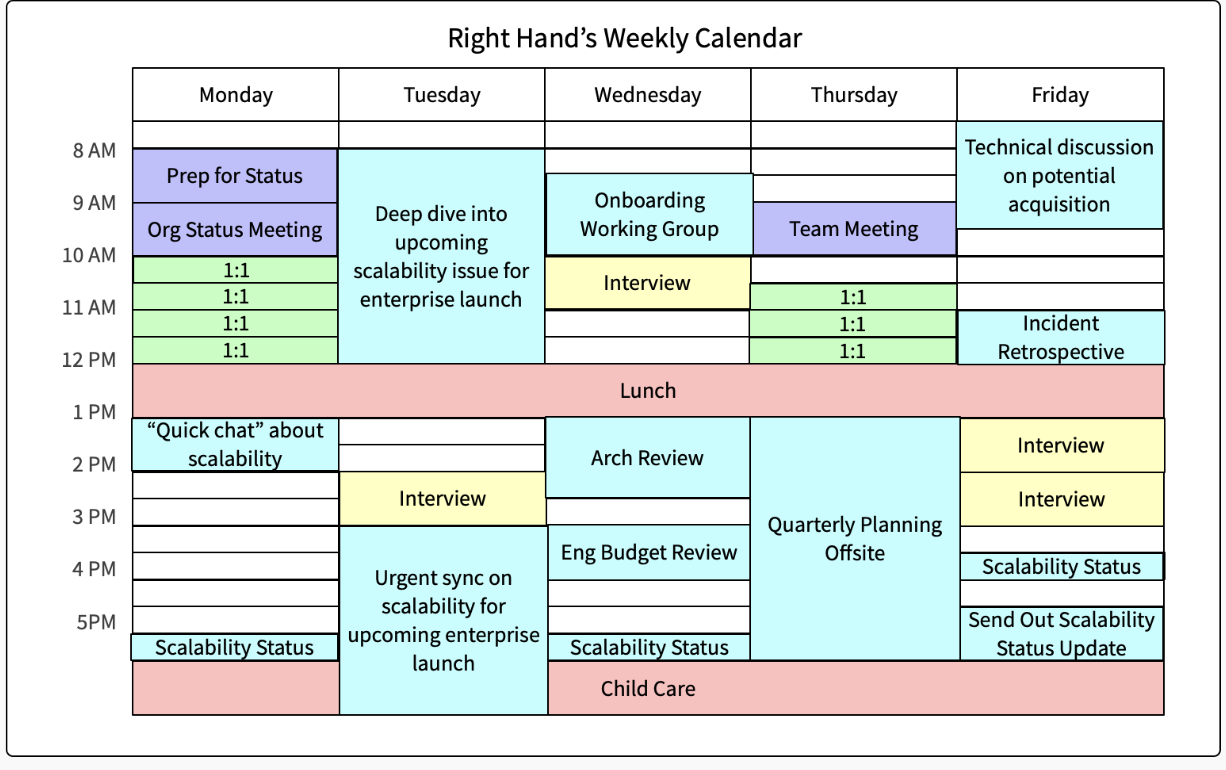
- Extends an executive’s attention borrowing their scope and authority particularly complex organizations.
- Similar to being an executive except “technical executive” like Werner Vogel @ AWS. Someone who can speak very technical details at the same time have executive reach. Day to day, he/she probably does not implement all the things he think about.
- Is the least common the archetypes.
- May have influence over hundreds of engineers.
- Similar to the “Hand of the King” in Game of thrones.
- Attends leadership meetings that are often not purely technical, but intersection of business, technology, people, and process.
- Edits approach, delegate execution, and jump to next problem.
This is what I think the different roles means:

References:

 Coffee Break
Leave a comment