- Structured Communication style is an “effective” way of organising your ideas in a format that disperses complex information in a concise and easy to consume way.
- This is a life hack skill that can be used in various settings such as decision making, triggering actions, divulging information, planning and executions.
- You should attempt to use Structured Communication when possible. It will save a lot of time and get your readers to connect with you immediately.
- I learned about this style after joining a startup company called “Atlas” which has a slightly different flavour of the traditional approach. In many references online, you’ll see this is also called the “Pyramid Principle” trademarked at Mckinsey Consulting.
Let’s jump right into some examples.
Convincing your boss to work on some tech debts.
Unstructured
You: Hi Boss, can we bring in some tech debt fixes for this sprint?
Boss: We got to bring in new product features to attract more customers. Let's work on the tech debts later since they do not contribute any real value.
You: The fixes will decrease the chance having outages.
Boss: New products always have outages, I think current customers are fine with it. The new customers will offset the losses and we also need to experiment with the new features right away.
You: The tech debt will affect current customers and new customers.
Structured
You: Hi Boss, let's bring in the tech debt fixes immediately as it will address the product outages. We risk losing existing and new customers as they fear our product is not reliable to use - hence working on the tech debts will directly protect our current revenue stream and future revenue streams.
Boss: We have a lot of new features with tight deadlines. Can I understand what are the fixes and how long it would take?
You: I understand the current feature deadlines we have. We can address the biggest issue right now which is the CDN does not...(etc). This issue may not affect the feature deadlines that much if we work on it early.
Both example shows you want to bring in tech debt in the first message. But the second one is better because it provides more sense of urgency and already answers the question what your boss may ask. The conclusion is provided as well. The second one gets the boss to be curious immediately how to get the most value for tech debt fixes while the first example you and your boss is still ironing out why the tech debt is needed.
Announcing New Coffee Machine in Office:
Unstructured
Hey guys,
I hope you're all doing well. I just wanted to let you know that the new coffee machine has arrived and it's awesome! We got it from the top-rated coffee maker brand in the market, and it's got all the bells and whistles you could imagine. It grinds the coffee beans, it froths the milk, and it even makes iced coffee! We're all really excited to try it out, so stop by the break room and give it a whirl.
Thanks,
Structured
Hey guys,
I have great news! The new coffee machine has arrived and it's amazing. We got it from the top-rated coffee maker brand in the market, and it has all the features you could want, including the ability to grind coffee beans, froth milk, and make iced coffee.
So if you need a pick-me-up, head to the break room and give it a try.
Thanks,
In this example, the unstructured style presents the main message in a long-winded way, with too much information about the coffee machine. The structured style presents the key information upfront, focusing on the main benefits of the new coffee machine, and making it easier for the reader to understand the important details.
Deciding Lunch
Unstructured

Boyfriend: "What are you getting for lunch?"
Girlfriend: "I don't know. Something."
Boyfriend: "Well, what would you get?"
Girlfriend: "Sushi?"
Boyfriend: "Hmm... I had that last week with some friends. Can we choose something else?"
~Conversation continues...~
Structured
Boyfriend: "I need some ideas for lunch together and probably not sushi. Do you have any suggestions?"
Girlfriend: "We could try that new Italian place that just opened up, or there's a sandwich shop down the street that we haven't been to in a while. What do you think?"
Boyfriend: "I think Italian sounds good, let's try that."
In the first example, the boyfriend is asking what the girlfriend wants for lunch. But the boyfriend failed to convey that he wants the same food with the girlfriend but not sushi. The message meaning is dramatically different after rephrasing some things in the structured style.
Structured Communication Format
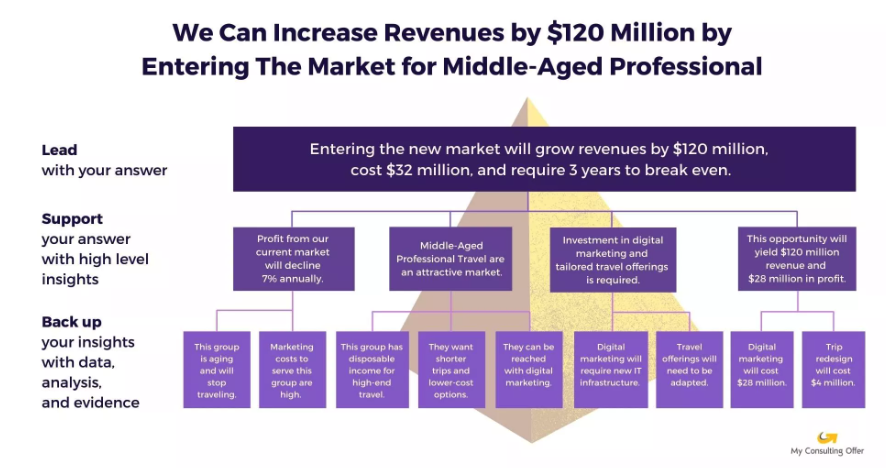
- Always start with the main message/recommendation in a top down tone. This give the reader the context what the information is about immediately and the rest of the sentences will become easier to consume. Most people will read the starting sentences and opt to skip the rest of the paragraphs if they already agree with the recommendation/message. This is especially true if they have time constraint.
- After the main message, present your supporting ideas on the “why”. This is the area you can provide more detailed analysis and information. Group the supporting ideas into some type of logical manner if it’s especially a complex idea. Couple of approaches below:
- Chronologically – the set of ideas has a causal/effect relationship. The detailed information is in sequence of events and the final idea can be traced to the beginning.
- Structural – There’s no particular order, but a bunch of major supporting ideas. You can group your paragraphs to separate major ideas describing the individual points to make sure all points are covered cohesively.
- Degree of Order – Some ideas can be more important than others. You want the readers to work their way from the most important ones to the least important one. This is also great if you want to ensure certain paragraphs has higher chance of being read.
- Keep your messages short and concise. Remove filler words. Write like a human being. Readers tend to be more forgetful when coming across difficult technical jargon words or long-winding-before-getting-to-the-point sentences. For demonstration, I provided two styles below explaining what are “black holes” :
- “There are interesting phenomena’s such as gravitational lensing, Hawking radiation, and the no-hair theorem in extreme cases. Regions of spacetime characterized by infinite curvature and density where the gravitational pull is so strong that nothing, not even light, can escape are known as black holes. Black holes arise as the end state of massive stars which have collapsed into a singularity surrounded by an event horizon, a surface beyond which any matter or radiation is forever trapped.
- “Black holes are places in space where gravity is so strong that nothing, not even light, can escape. They form when a massive star collapses in on itself, creating a tiny point of infinite gravity and density called a singularity. Anything that gets too close to a black hole, including stars and planets, gets pulled in and trapped forever. Even though we can’t see them directly, scientists can study the effects of black holes on their surroundings and learn more about how they work.”
- Create “action items” at the end if you expect the reader to do something after reading your message. This idea came from “Atlas”. The action items keeps your reader being part of the stake of ownership. Personally, it has helped me to make sure the message was read correctly and acknowledging it.
- For example consider there is a hard timeline you need your colleagues to know. A database migration and momentarily scheduled downtime.
- You: Hello team. This is just a reminder that there will be a scheduled downtime of 1 hour for database migration next Friday at 12AM.
- Action Items:
- 1. Please thumbs up if you read this message
- 2. Please reply to this message if your team cannot have this kind of downtime.
- Action Items:
In Summary
Why Structured Communication Works?
- It is not always easy to compile a set of complex ideas into a concise and well formatted “Structured Communication” format. At times I myself may spend 30 minutes to 1 hour to try synthesise my ideas together that I feel would create the effect I wanted. Every amount of effort spent removes reader’s “barriers of understanding”. And what are those barriers? A bunch of unrelated information.

- Assume you’re the subject matter expert. Provide a top down approach for conveying ideas instead of bottom-up gets the audience to internalize your ideas. It provides the context of the document immediately through the conclusion and gets readers to look for details in the later sentences.
- The brain cannot remember the details if there are no connections between them. So starting your documents with details will make the reader try to sift through information first, and lose focus on what the detail means. This is solved if you give the conclusion immediately and then readers know the details are related to the conclusion. They will then spend more time understanding the detail which usually contains lot more complex ideas.
- It speeds up decision making process because you’re providing a recommendation first. It doesn’t necessarily mean the decision it solidified, and you could always allow inputs in the “Action Items”. It works well in asynchronous environments.
- It assumes people are time stricken and have short attention span. (Which is true). Structured Communication adopts the style of enough simplicity and straight to the point. In documents, it may decrease the amount of words required to convey the same meaning. With the format organization, it ensures higher probability that the main ideas are conveyed immediately.
Action Items For You:
- Use “Structured Communication” on your day to day interactions such as Slack, Emails, Memos, Solution Documents, and Performance Reviews.
- Click the Like Button, Subscribe, and Share this post if you want the world to convey ideas better.
Honourable mentions of other communication styles:
- The Rule of Three: The Rule of Three can be effective for any type of communication where you want to make a point or support an argument. It is especially useful for presentations or speeches.
- Storytelling: Storytelling can be effective for any type of communication where you want to engage your audience and make a message more memorable. It is particularly useful for marketing and advertising, as well as for presentations or speeches.
References:

 Coffee Break
Leave a comment