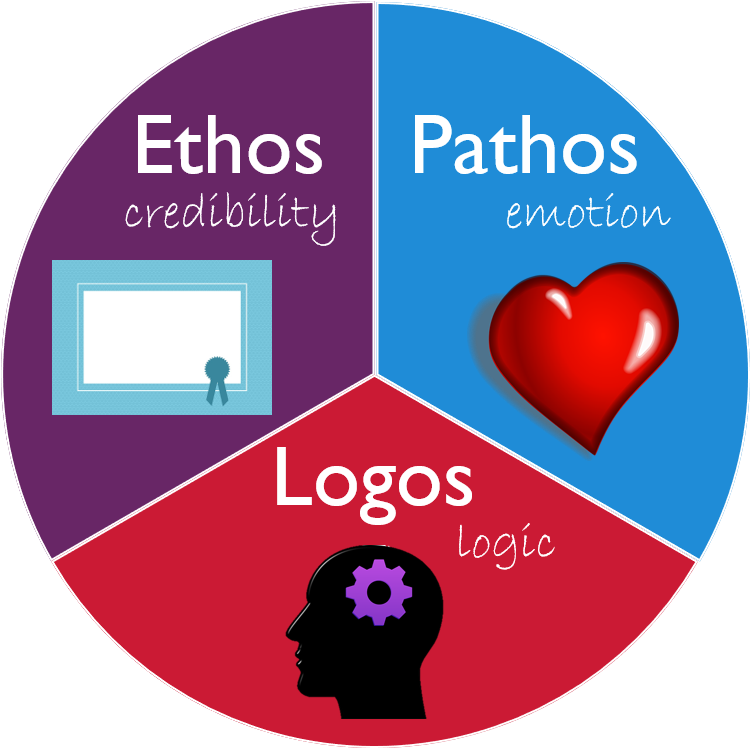
- Ethos, Pathos, Logos are three categories of the rhetoric triangle coined by Aristotle more than 2000 years ago. It is impressive that its concepts are still used today, especially in advertisement.
- Modern persuasion techniques has since evolved to be more specific, though the rhetoric triangle I believe, is still a great way to use as a reference to ensure a persuasion uses at least 2 of the 3 categories.
- A fourth category lesser known is called “Kairos“.
Ethos
- Ethos is the mode of persuasion that appeals to the credibility and trustworthiness of the speaker or author.
- How to execute?
- Personal anecdotes: By sharing personal experiences or stories, the speaker can establish themselves as someone with personal knowledge and expertise on the topic.
- Expert testimony: By citing the opinions or research of experts in the field, the speaker can establish themselves as someone who has done their research and is well-informed on the topic.
- Professional credentials: By mentioning relevant degrees, certifications, or professional affiliations, the speaker can establish themselves as someone who has the necessary qualifications and expertise to speak on the topic.
- Tone and style: By using a confident, knowledgeable, and authoritative tone, the speaker can convey their expertise and competence to the audience.
- Ethos is easily recognizable in advertisements where a celebrity is used to endorse a product or service. This is becoming much more prevalent in other e-commerce platforms such as TikTok, Youtube, Instagram.
- I would buy the sneakers below since Curry endorses it.
Subcategories of Ethos:
- Plain Folks – Portraying oneself as an ordinary person who shares the values and experiences of the audience.
- Celebrity Endorsements – Using the endorsement of a celebrity or well-known figure to persuade an audience.
- Consistency – Using one’s past actions or statements to establish credibility and build trust with an audience.
- Trustworthiness – Building trust with an audience through transparency, honesty, and reliability.
Pathos
- Pathos is the mode of persuasion that appeals to the emotions and values of the audience.
- How to execute?
- Anecdotes and stories – telling emotional stories or sharing personal experiences, the speaker can connect with the audience on a personal level and evoke feelings of empathy and compassion.
- Vivid imagery and sensory details: By using descriptive language that appeals to the senses, the speaker can create a vivid and emotional picture in the audience’s mind.
- Metaphors and analogies – using comparisons that resonate with the audience’s experiences and values, the speaker can evoke emotions and create a sense of connection with the audience.
- Inclusive language – using language that includes the audience and creates a sense of community, the speaker can appeal to the audience’s sense of belonging and identity.
- Fear – Using fear to motivate people to take action.
- For example, a public health campaign might use images of the negative consequences of an unhealthy behaviour to encourage people to make positive changes.
- It can also be a technique to demotivate people not to take action (deterrence).
- For example: A government imposing extremely heavy punishments pertaining to a specific action in an international setting
- Humor – Create a positive emotional response and make a message more memorable.
- For example, a company might use a humorous advertisement to promote a product.
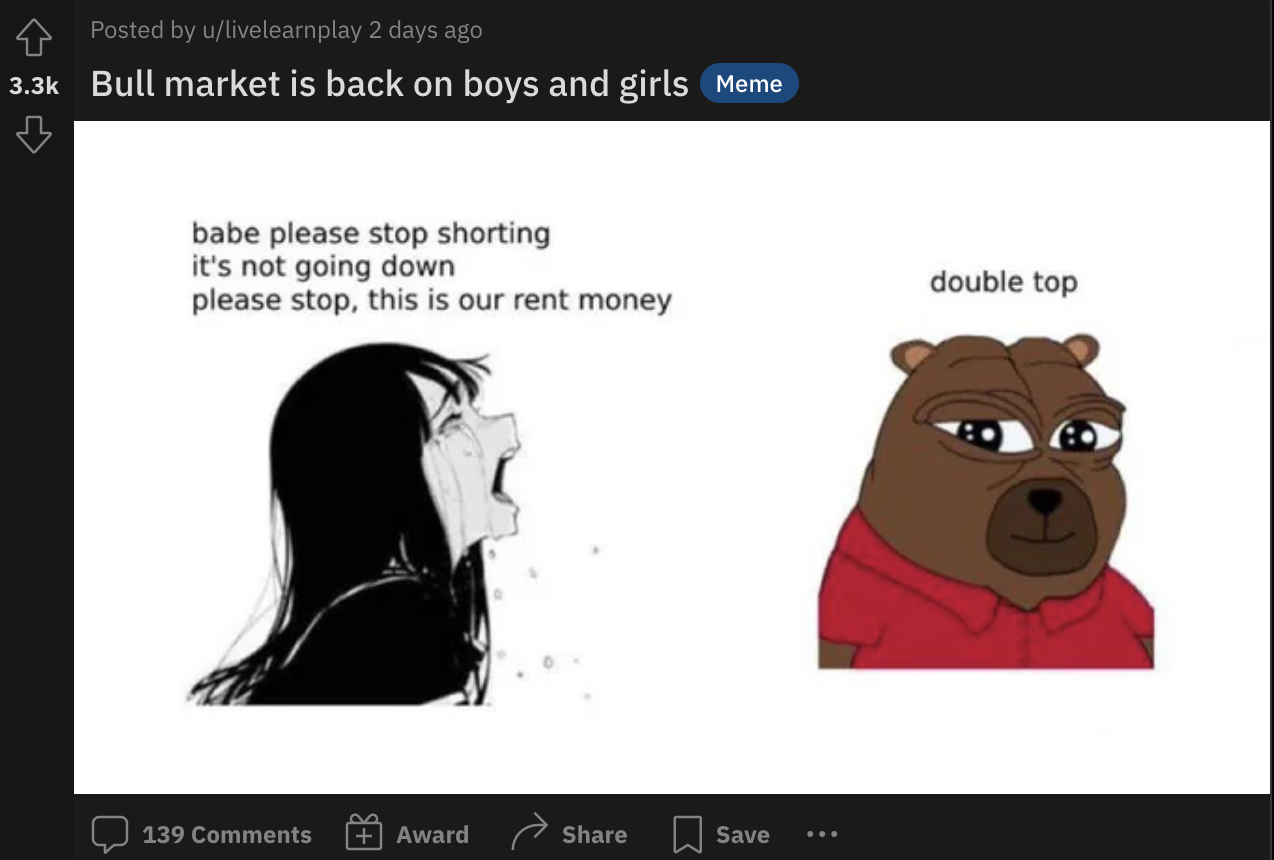
- The use of Humorous Memes in Reddit can also be identified as a facade of an underlying message. #WallStreetBets are full of these examples
- Below the message “Bull market is back on boys and girls”
- Message: To encourage amateur investors to put more money into stocks in anticipation that the prices of stocks will go up.
- However veterans will know that currently the economy is in recession and there aren’t any specific reasons to invest right now.
- #WallStreetBets is notorious for having “WallStreet” sharks to prey on new investors. The idea is, the author likely is in short position, and having some investors inflating stock prices could decrease their losses.
- For example, a company might use a humorous advertisement to promote a product.
- Sex Appeals – Using sexual content or imagery to evoke emotions such as desire, arousal, or excitement in an audience. This is a common technique in advertisements.
Subcategories of Pathos
- “Bandwagon” – The message where there is a specific action that puts the audience on the winning team if they take it.
- “Loaded Language” – using emotionally charged language to evoke a particular response from the audience.
- For example, a news article might describe a political figure as “heartless” or a charity might refer to those in need as “the forgotten.”
- “Appeals to Tradition” – appealing to audience’s respect for tradition and the way things have always been done.
- For example, a political candidate might argue that they will uphold “traditional values” or a company might market a product as being made “the old-fashioned way.”
- “Appeals to Beliefs and Values” – appealing to the audience’s core beliefs and values.
- For example, a charity might appeal to a person’s sense of altruism or a politician might appeal to a person’s sense of justice.
- “Repetition” – repeating a message or idea multiple times to reinforce its emotional impact on the audience.
- For example, a marketer might repeat a slogan or catchphrase in their advertisements to increase brand recognition.
- Ex: Don Don Donki Song
Logos
- The mode of persuasion that appeals to the audience’s reason and logic.
- How to execute?
- Statistics and data – presenting factual information and data, the speaker can provide evidence to support their argument and appeal to the audience’s sense of reason.
- Logical arguments and reasoning – constructing a clear and logical argument, the speaker can appeal to the audience’s sense of reason and persuade them to accept their viewpoint.
- Analogies and comparisons – using comparisons that highlight similarities or differences, the speaker can help the audience understand complex ideas and concepts. This is quite common in technology comparison of products like new iphone vs android.
Subcategories of Logos
- “Slippery Slope” (Causal Reasoning) – This technique involves showing a causal relationship between two events.
- For example, “Smoking causes cancer.”
- Syllogism (Deductive Reasoning) – This technique involves using general premises to draw a specific conclusion.
- For example, “All dogs are mammals. My pet is a dog. Therefore, my pet is a mammal.”
- Inductive Reasoning – This technique involves using specific observations to make a general conclusion.
- For example, “Every bird I have seen has feathers. Therefore, all birds have feathers.”
- Logical Fallacies – These are techniques or errors in reasoning that make an argument flawed or illogical. Some examples include
- Ad Hominem (attacking the person making the argument rather than the argument itself)
- False Dilemma (presenting only two options as if they are the only possibilities)
- Hasty Generalization – The hasty generalization fallacy is pretty self-explanatory. It entails drawing conclusions based on limited information or generalizing a group based on a small number of individuals belonging to it. This is quite common in medical related advertisements like below.

Kairos
- Refers to the opportune moment or timing for making an argument or taking action. It is the idea that there is a right time and place for making a particular argument or taking a particular action, and that the effectiveness of the argument or action can depend on the context in which it is made.
- The use of Kairos requires an awareness of the audience, the context, and the current events or circumstances that surround the argument or action. By being attuned to these factors, a speaker can choose the most effective moment to make their argument or take their action, and can tailor their message to the particular audience and context in which it will be received.
- How to execute?
- Occasion: specific event or situation in which an argument or action is being made.
- For example, a political candidate might tailor their message to the specific audience and context of a debate or town hall meeting.
- Timing: specific moment in which an argument or action is being made.
- For example, an advertisement might be timed to coincide with a major sporting event or cultural holiday.
- Cultural Relevance: the extent to which an argument or action is relevant to the cultural moment or zeitgeist.
- For example, a social media post might capitalize on a popular meme or trend to increase its virality and impact.
- Occasion: specific event or situation in which an argument or action is being made.
- Real life examples:
- A Chinese General “Xiang Yu” against all odds won a battle using 20,000 soldiers against 200,000 enemy soldiers at the battle of Julu in 207 BC
- There’s no clear advantage of Xiang Yu’s army but he created a “fight or die” circumstance among his soldiers by commanding the army to carry only 3 days worth of food, destroying their own ship transport, as well as all cookware utensils. Thereby there is no chance of survival unless the army wins the battle and loot their enemy’s supplies.
- Maybe this is not coined officially I’ll gladly call it “To Reach The Point of No Return” Persuasion Technique.
- A Chinese General “Xiang Yu” against all odds won a battle using 20,000 soldiers against 200,000 enemy soldiers at the battle of Julu in 207 BC
Other Notable Persuasion Techniques
- Reciprocity – Giving something to an audience with the expectation that they will reciprocate by taking the desired action.
- The free Red Bulls given by brand ambassadors
- Scarcity – Emphasizing the limited availability of a product or opportunity to motivate people to take action.
- De Beers – Diamond Scarcity
- Foot-in-the-Door – Getting someone to agree to a small request before making a larger request. By getting someone to agree to a small request, they become more likely to agree to a larger request later.
- Initial freemium plans in subscriptions with important features behind paid walls.
- Door-in-the-Face – Making an initial request that is deliberately large and unreasonable before making a smaller, more reasonable request. By making the second request seem more reasonable in comparison, people are more likely to agree to it.
- Asian Bazaar Vendors initially offering $200 fake Gucci Bags to potential customers and then eventually lowering down to $50.
- Inoculation Theory – This technique involves exposing people to weak versions of opposing arguments in order to strengthen their resistance to those arguments. By inoculating people against opposing arguments, speakers can make their own arguments more persuasive.
- Two-Sided Messages – Presenting both the pros and cons of a particular argument in order to make the message more balanced and credible. By acknowledging potential weaknesses in their argument, speakers can build trust with their audience and make their argument more persuasive.
Takeaways
- To summarise – in order to use the rhetoric triangle effectively, make sure the persuasion uses at least 2 of the 3 categories. The more, the better.
- Combination Templates
- Generic “TEDX Talks”
- Start with Pathos: Begin by establishing an emotional connection with your audience. This could be a Storytelling technique of a personal anecdote.
- Use Logos to Support Your Argument: Use logical arguments, facts, and evidence to support your position. This might include citing statistics, your journey, past failures and learnings from the anecdotes.
- Build Ethos Throughout: Build credibility by showing milestones achieved, expert partnerships, other people’s testimony
- Appeal to Pathos Again: Restating your personal story or using powerful language to evoke emotion.
- Conclude with a Strong Call to Action: End with a clear and compelling call to action that motivates your audience to take action based on your argument.
- Convincing Team to use new Programming language or Technologies
- Start with Logos: Begin by presenting the technical advantages of the new programming language, such as improved performance, better scalability, or easier maintenance. Use data, benchmarks, and case studies to demonstrate that the new language is superior to the old one.
- Address potential objections: Acknowledge and address the potential objections that the team may have about switching to a new language, such as the learning curve, compatibility issues, or lack of support. Use logic and evidence to show that these objections can be overcome or are not as significant as they may seem.
- Use Ethos: Establish your credibility and expertise on the subject by sharing your own experience with the new language or highlighting the achievements of other companies or developers who have successfully adopted it. Use testimonials, endorsements, or success stories to build trust and authority.
- Use Pathos: Connect with the emotions of the team by emphasizing the benefits of the new language beyond the technical aspects, such as increased productivity, creativity, or job satisfaction. Show how the new language aligns with the team’s values, goals, or vision for the future.
- Address implementation: Provide a clear and practical plan for implementing the new language, including training, support, and resources. Address any concerns about the transition process and ensure that the team feels confident and supported throughout the change.
- Call to action: End with a clear and compelling call to action, such as scheduling a trial period, setting up a pilot project, or starting a training program. Encourage the team to embrace the new language as an opportunity for growth, learning, and innovation.
- Generic “TEDX Talks”
- If I haven’t gotten enough subscribers, you’ll likely see more Pathos and Logos advertisement below. 🙂 Please subscribe!
References
- https://www.studiobinder.com/blog/ethos-pathos-logos/ – Original Article
- https://www.youtube.com/watch?v=lmR58_dqLxY – Advertisement examples
- https://www.wix.com/wordsmatter/blog/2020/12/ethos-pathos-logos/
- https://www.brid.tv/fallacies-in-advertising/#16-post-hoc-ergo-propter-hoc
- https://simplypsychology.org/compliance.html – techniques of Compliance

 Coffee Break
Leave a comment